
Design Isn’t the Deliverable — Outcomes Are
Introduction
Too often, design is treated as a checklist item: wireframes delivered, UI signed off, product shipped. But design isn’t the deliverable — outcomes are. And when teams lose sight of that, even beautifully crafted products can fail to make an impact.
At its best, design is a problem-solving discipline focused on change: changing behaviour, reducing friction, increasing confidence, or helping users achieve something more easily than before.
The Trap of “Done”
In many projects, success is measured by completion:
- The screens are finished
- The prototype is approved
- The site is live
But none of those things guarantee value. A product can be “done” and still:
- Confuse users
- Miss key business goals
- Create more support tickets than it solves
Design that stops at delivery risks optimising for output instead of impact.
Shifting the Focus to Outcomes
Outcome-driven design starts by asking different questions:
- What problem are we actually trying to solve?
- How will we know if this worked?
- What behaviour do we want to enable or change?
Instead of focusing purely on features or visuals, the emphasis shifts to:
- Task completion
- Reduced friction
- Increased clarity
- Measurable improvement in user or business metrics
This mindset reframes design as a strategic tool, not just a creative one.
Design as a Hypothesis
Every design decision is, at its core, a hypothesis:
“If we change this, we believe that will improve.”
Good teams test those assumptions early and often:
- Through prototypes
- Through usability testing
- Through real-world feedback and analytics
When something doesn’t work, it’s not a failure — it’s data. Iteration becomes part of the process, not a sign that something went wrong.
The Role of UX in Outcome-Led Work
UX plays a crucial role here by:
- Grounding decisions in user research
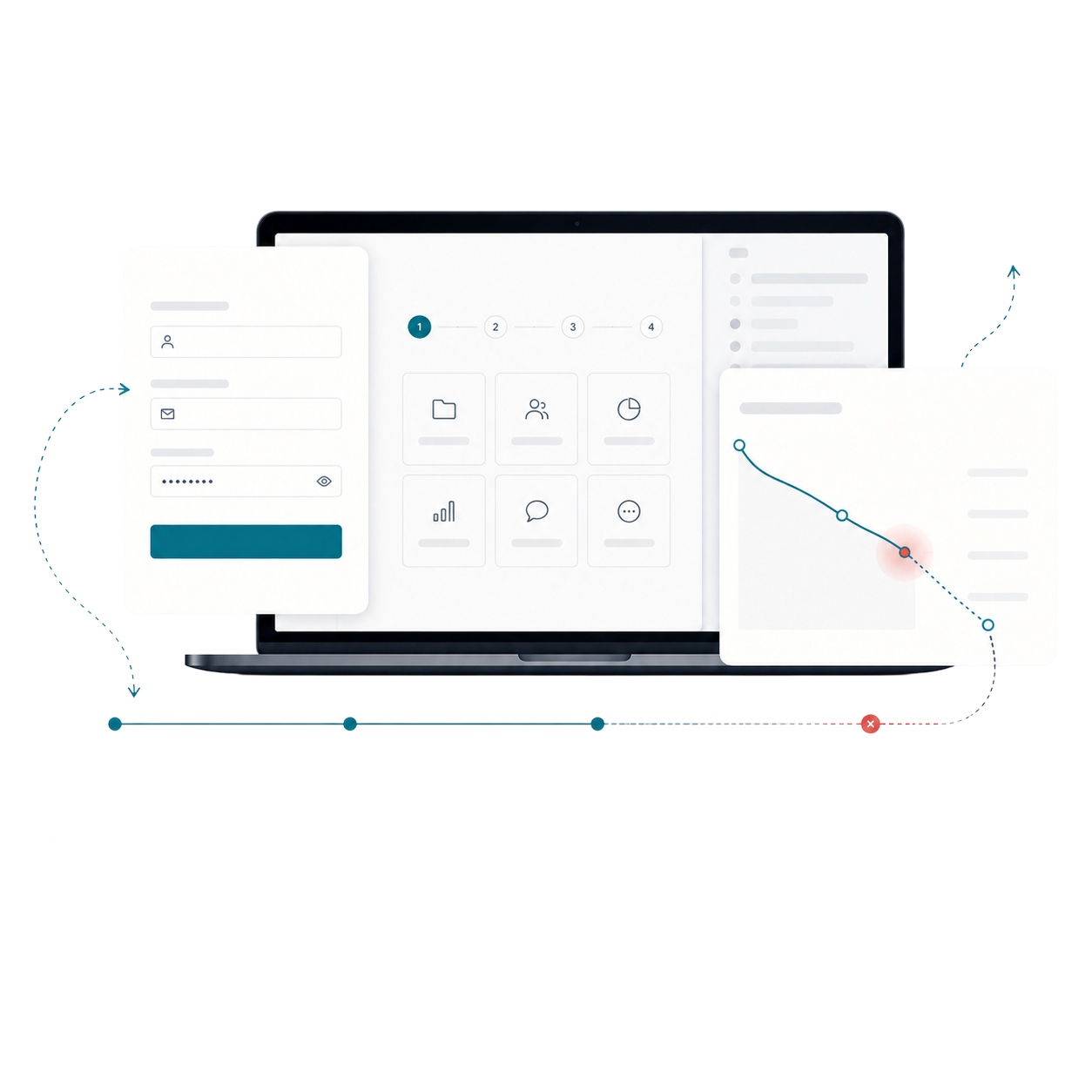
- Mapping journeys and identifying friction points
- Validating ideas before they become expensive to change
Rather than being an isolated phase, UX becomes an ongoing conversation between users, teams, and the product itself.
What This Means for Clients & Teams
When you focus on outcomes:
- Stakeholders gain clarity on why decisions are made
- Teams align around shared goals instead of opinions
- Products evolve based on evidence, not assumptions
Design stops being subjective and starts being accountable.
Conclusion
Design isn’t about shipping artefacts — it’s about delivering results. When we measure success by outcomes rather than outputs, design becomes one of the most powerful levers a business can pull.
That’s where real value is created — and where meaningful digital experiences begin.
START WITH THE PROBLEM
Have a product, store or digital experience that needs clearer thinking?
I help SaaS founders, Shopify brands and agencies diagnose friction, design better journeys and deliver interfaces that can actually be built.


UX · PRODUCT · SHOPIFY · DEVELOPMENT
I solve usability problems before they become business problems — connecting UX, product thinking and build-ready delivery.

Available for selected remote projects


© 2026 Steve Roberts / ME&CO. All rights reserved.



MENU

Design Isn’t the Deliverable — Outcomes Are
Introduction
Too often, design is treated as a checklist item: wireframes delivered, UI signed off, product shipped. But design isn’t the deliverable — outcomes are. And when teams lose sight of that, even beautifully crafted products can fail to make an impact.
At its best, design is a problem-solving discipline focused on change: changing behaviour, reducing friction, increasing confidence, or helping users achieve something more easily than before.
The Trap of “Done”
In many projects, success is measured by completion:
- The screens are finished
- The prototype is approved
- The site is live
But none of those things guarantee value. A product can be “done” and still:
- Confuse users
- Miss key business goals
- Create more support tickets than it solves
Design that stops at delivery risks optimising for output instead of impact.
Shifting the Focus to Outcomes
Outcome-driven design starts by asking different questions:
- What problem are we actually trying to solve?
- How will we know if this worked?
- What behaviour do we want to enable or change?
Instead of focusing purely on features or visuals, the emphasis shifts to:
- Task completion
- Reduced friction
- Increased clarity
- Measurable improvement in user or business metrics
This mindset reframes design as a strategic tool, not just a creative one.
Design as a Hypothesis
Every design decision is, at its core, a hypothesis:
“If we change this, we believe that will improve.”
Good teams test those assumptions early and often:
- Through prototypes
- Through usability testing
- Through real-world feedback and analytics
When something doesn’t work, it’s not a failure — it’s data. Iteration becomes part of the process, not a sign that something went wrong.
The Role of UX in Outcome-Led Work
UX plays a crucial role here by:
- Grounding decisions in user research
- Mapping journeys and identifying friction points
- Validating ideas before they become expensive to change
Rather than being an isolated phase, UX becomes an ongoing conversation between users, teams, and the product itself.
What This Means for Clients & Teams
When you focus on outcomes:
- Stakeholders gain clarity on why decisions are made
- Teams align around shared goals instead of opinions
- Products evolve based on evidence, not assumptions
Design stops being subjective and starts being accountable.
Conclusion
Design isn’t about shipping artefacts — it’s about delivering results. When we measure success by outcomes rather than outputs, design becomes one of the most powerful levers a business can pull.
That’s where real value is created — and where meaningful digital experiences begin.
START WITH THE PROBLEM
Have a product, store or digital experience that needs clearer thinking?
I help SaaS founders, Shopify brands and agencies diagnose friction, design better journeys and deliver interfaces that can actually be built.


UX · PRODUCT · SHOPIFY · DEVELOPMENT
I solve usability problems before they become business problems — connecting UX, product thinking and build-ready delivery.
Available for selected remote projects


© 2026 Steve Roberts / ME&CO. All rights reserved.

HOME
MENU

HOME
MENU
Design Isn’t the Deliverable — Outcomes Are

Introduction
Too often, design is treated as a checklist item: wireframes delivered, UI signed off, product shipped. But design isn’t the deliverable — outcomes are. And when teams lose sight of that, even beautifully crafted products can fail to make an impact.
At its best, design is a problem-solving discipline focused on change: changing behaviour, reducing friction, increasing confidence, or helping users achieve something more easily than before.
The Trap of “Done”
In many projects, success is measured by completion:
- The screens are finished
- The prototype is approved
- The site is live
But none of those things guarantee value. A product can be “done” and still:
- Confuse users
- Miss key business goals
- Create more support tickets than it solves
Design that stops at delivery risks optimising for output instead of impact.
Shifting the Focus to Outcomes
Outcome-driven design starts by asking different questions:
- What problem are we actually trying to solve?
- How will we know if this worked?
- What behaviour do we want to enable or change?
Instead of focusing purely on features or visuals, the emphasis shifts to:
- Task completion
- Reduced friction
- Increased clarity
- Measurable improvement in user or business metrics
This mindset reframes design as a strategic tool, not just a creative one.
Design as a Hypothesis
Every design decision is, at its core, a hypothesis:
“If we change this, we believe that will improve.”
Good teams test those assumptions early and often:
- Through prototypes
- Through usability testing
- Through real-world feedback and analytics
When something doesn’t work, it’s not a failure — it’s data. Iteration becomes part of the process, not a sign that something went wrong.
The Role of UX in Outcome-Led Work
UX plays a crucial role here by:
- Grounding decisions in user research
- Mapping journeys and identifying friction points
- Validating ideas before they become expensive to change
Rather than being an isolated phase, UX becomes an ongoing conversation between users, teams, and the product itself.
What This Means for Clients & Teams
When you focus on outcomes:
- Stakeholders gain clarity on why decisions are made
- Teams align around shared goals instead of opinions
- Products evolve based on evidence, not assumptions
Design stops being subjective and starts being accountable.
Conclusion
Design isn’t about shipping artefacts — it’s about delivering results. When we measure success by outcomes rather than outputs, design becomes one of the most powerful levers a business can pull.
That’s where real value is created — and where meaningful digital experiences begin.









START WITH THE PROBLEM
Have a product, store or digital experience that needs clearer thinking?
I help SaaS founders, Shopify brands and agencies diagnose friction, design better journeys and deliver interfaces that can actually be built.


UX · PRODUCT · SHOPIFY · DEVELOPMENT
I solve usability problems before they become business problems — connecting UX, product thinking and build-ready delivery.
Available for selected remote projects


© 2026 Steve Roberts / ME&CO. All rights reserved.

ABOUT
UX CONSULTANT
UX RESEARCH
UI & GRAPHICS
SOFTWARE
PORTFOLIO
RESOURCES
BOOKS
BLOG
