
Why UX Strategy Isn’t Optional Anymore: The Business Case for Design Thinking
Introduction
In today’s digital world, companies that invest in design aren’t just making products that look nice — they’re shaping experiences that people love and return to. But great visuals alone don’t move the needle. What truly differentiates successful products is UX strategy — a thoughtful, research-backed plan that aligns user needs with business goals.
What Is UX Strategy?
At its core, UX strategy combines user research, business objectives, and design thinking to craft experiences that are useful, usable, and impactful. It’s the blueprint that tells teams why decisions are made, not just what to build.
It’s about:
- Understanding real user pain points
- Defining clear product goals
- Benchmarking against competitors
- Prioritising features that matter most
Why It Matters to Businesses
Without strategy, design becomes guesswork. A UX strategy ensures that:
- Development resources are used effectively
- Products solve real problems (not imagined ones)
- Teams remain aligned behind shared goals
- Outcomes are measurable and accountable
This isn’t subjective — companies that integrate UX research and strategic design see increases in engagement, retention, conversion and customer satisfaction.
A Real-World Example
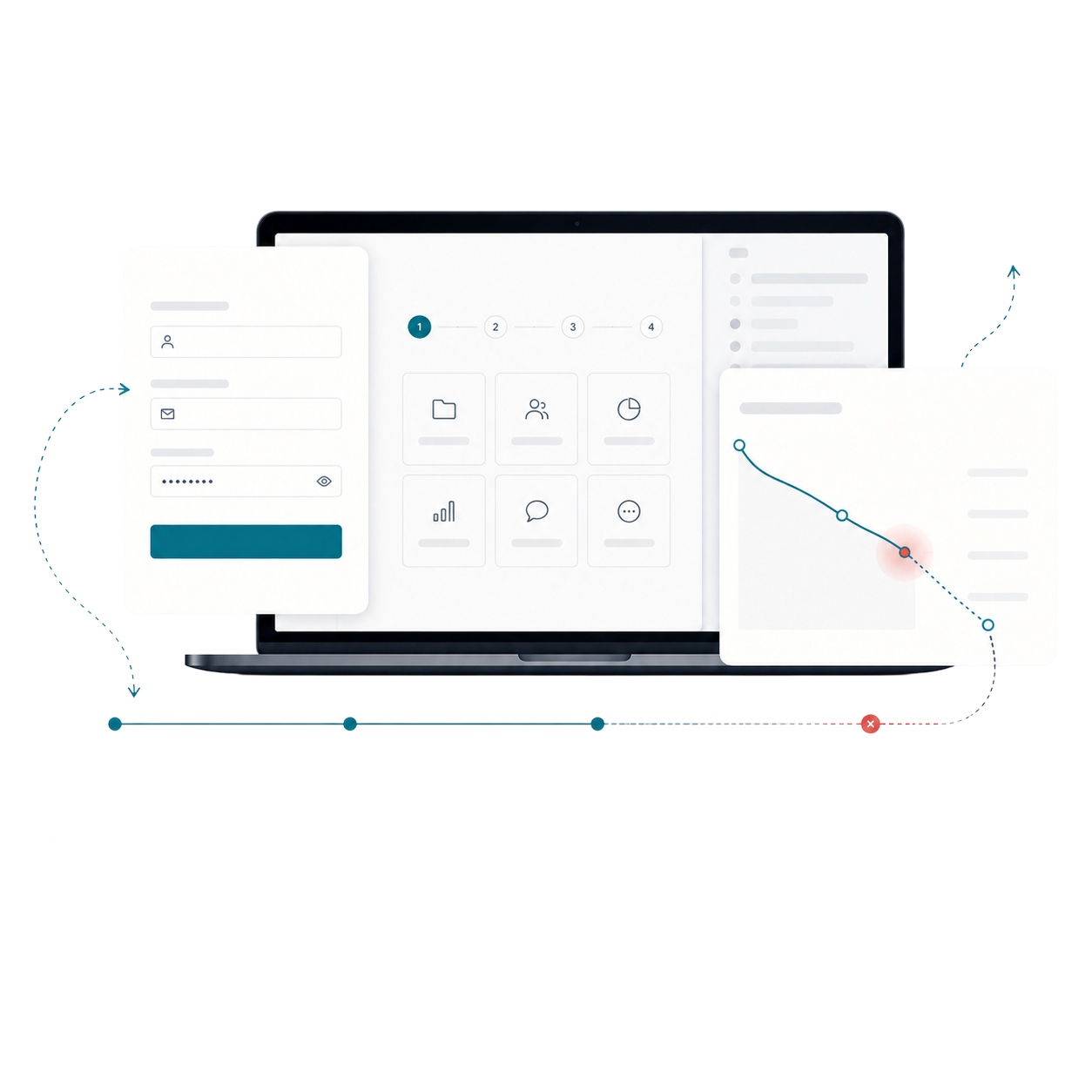
Imagine a SaaS platform struggling with adoption. Users sign up but drop off within days. A UX strategy reframes the problem: Instead of rushing to build features, we ask questions like:
- What users are trying to accomplish?
- Where do they get confused?
- What tasks feel frustrating or unnecessary?
From extensive user testing and journey mapping, we uncover insights that guide design decisions — leading to clearer interfaces, reduced friction, and happier users.
Conclusion
Good design looks good. Great design works — and that starts with strategy. If your product or service isn’t backed by a UX strategy, you’re leaving value — and growth — on the table.
START WITH THE PROBLEM
Have a product, store or digital experience that needs clearer thinking?
I help SaaS founders, Shopify brands and agencies diagnose friction, design better journeys and deliver interfaces that can actually be built.


UX · PRODUCT · SHOPIFY · DEVELOPMENT
I solve usability problems before they become business problems — connecting UX, product thinking and build-ready delivery.

Available for selected remote projects


© 2026 Steve Roberts / ME&CO. All rights reserved.



MENU

Why UX Strategy Isn’t Optional Anymore: The Business Case for Design Thinking
Introduction
In today’s digital world, companies that invest in design aren’t just making products that look nice — they’re shaping experiences that people love and return to. But great visuals alone don’t move the needle. What truly differentiates successful products is UX strategy — a thoughtful, research-backed plan that aligns user needs with business goals.
What Is UX Strategy?
At its core, UX strategy combines user research, business objectives, and design thinking to craft experiences that are useful, usable, and impactful. It’s the blueprint that tells teams why decisions are made, not just what to build.
It’s about:
- Understanding real user pain points
- Defining clear product goals
- Benchmarking against competitors
- Prioritising features that matter most
Why It Matters to Businesses
Without strategy, design becomes guesswork. A UX strategy ensures that:
- Development resources are used effectively
- Products solve real problems (not imagined ones)
- Teams remain aligned behind shared goals
- Outcomes are measurable and accountable
This isn’t subjective — companies that integrate UX research and strategic design see increases in engagement, retention, conversion and customer satisfaction.
A Real-World Example
Imagine a SaaS platform struggling with adoption. Users sign up but drop off within days. A UX strategy reframes the problem: Instead of rushing to build features, we ask questions like:
- What users are trying to accomplish?
- Where do they get confused?
- What tasks feel frustrating or unnecessary?
From extensive user testing and journey mapping, we uncover insights that guide design decisions — leading to clearer interfaces, reduced friction, and happier users.
Conclusion
Good design looks good. Great design works — and that starts with strategy. If your product or service isn’t backed by a UX strategy, you’re leaving value — and growth — on the table.
START WITH THE PROBLEM
Have a product, store or digital experience that needs clearer thinking?
I help SaaS founders, Shopify brands and agencies diagnose friction, design better journeys and deliver interfaces that can actually be built.


UX · PRODUCT · SHOPIFY · DEVELOPMENT
I solve usability problems before they become business problems — connecting UX, product thinking and build-ready delivery.
Available for selected remote projects


© 2026 Steve Roberts / ME&CO. All rights reserved.

HOME
MENU

Why UX Strategy Isn’t Optional Anymore: The Business Case for Design Thinking

Introduction
In today’s digital world, companies that invest in design aren’t just making products that look nice — they’re shaping experiences that people love and return to. But great visuals alone don’t move the needle. What truly differentiates successful products is UX strategy — a thoughtful, research-backed plan that aligns user needs with business goals.
What Is UX Strategy?
At its core, UX strategy combines user research, business objectives, and design thinking to craft experiences that are useful, usable, and impactful. It’s the blueprint that tells teams why decisions are made, not just what to build.
It’s about:
- Understanding real user pain points
- Defining clear product goals
- Benchmarking against competitors
- Prioritising features that matter most
Why It Matters to Businesses
Without strategy, design becomes guesswork. A UX strategy ensures that:
- Development resources are used effectively
- Products solve real problems (not imagined ones)
- Teams remain aligned behind shared goals
- Outcomes are measurable and accountable
This isn’t subjective — companies that integrate UX research and strategic design see increases in engagement, retention, conversion and customer satisfaction.
A Real-World Example
Imagine a SaaS platform struggling with adoption. Users sign up but drop off within days. A UX strategy reframes the problem: Instead of rushing to build features, we ask questions like:
- What users are trying to accomplish?
- Where do they get confused?
- What tasks feel frustrating or unnecessary?
From extensive user testing and journey mapping, we uncover insights that guide design decisions — leading to clearer interfaces, reduced friction, and happier users.
Conclusion
Good design looks good. Great design works — and that starts with strategy. If your product or service isn’t backed by a UX strategy, you’re leaving value — and growth — on the table.









START WITH THE PROBLEM
Have a product, store or digital experience that needs clearer thinking?
I help SaaS founders, Shopify brands and agencies diagnose friction, design better journeys and deliver interfaces that can actually be built.


UX · PRODUCT · SHOPIFY · DEVELOPMENT
I solve usability problems before they become business problems — connecting UX, product thinking and build-ready delivery.
Available for selected remote projects


© 2026 Steve Roberts / ME&CO. All rights reserved.

ABOUT
UX CONSULTANT
UX RESEARCH
UI & GRAPHICS
SOFTWARE
PORTFOLIO
RESOURCES
BOOKS
BLOG
